
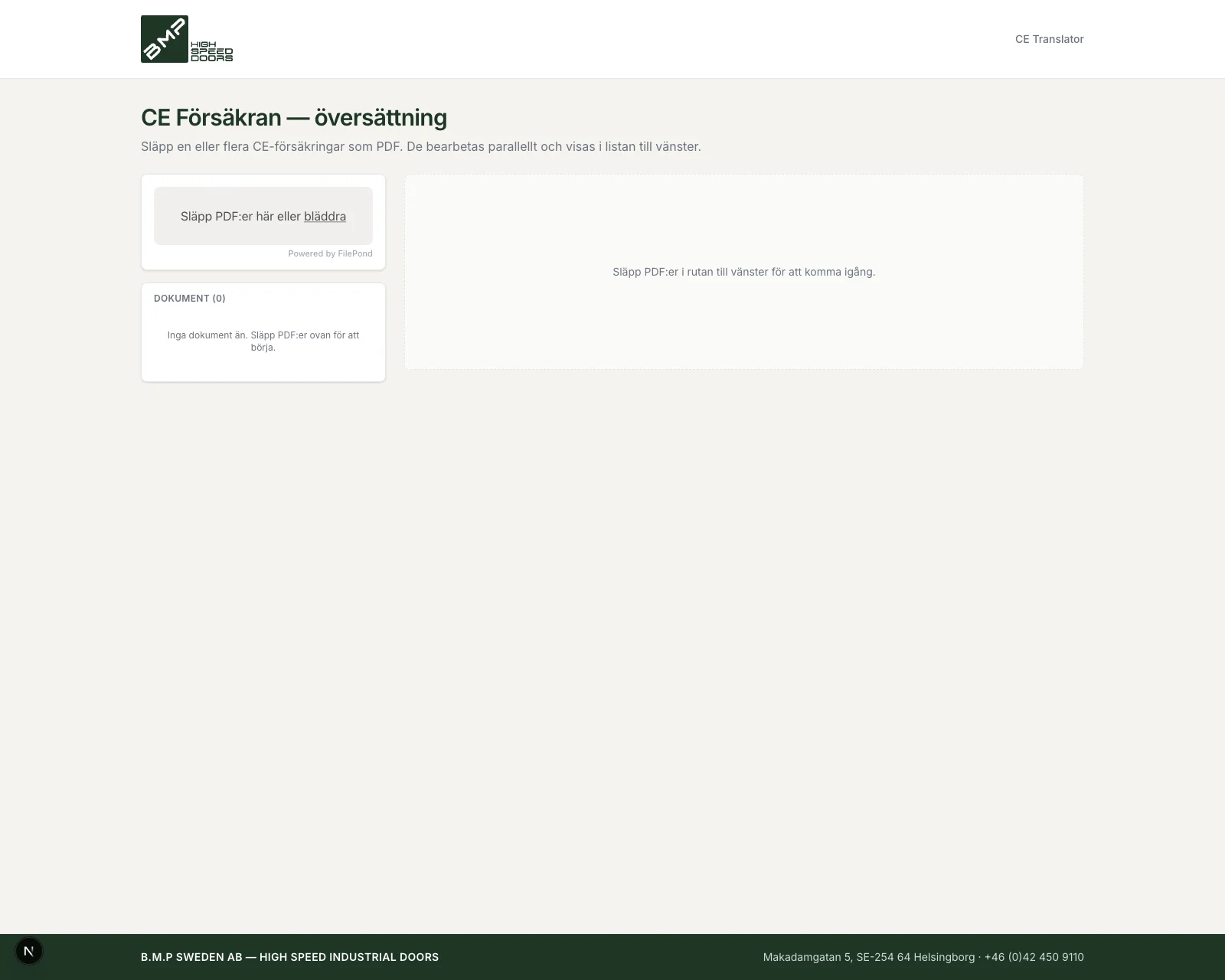
A purpose-built translator for CE Declarations of Performance — the formal compliance documents that ship with every product in regulated industries. The brief was narrow but high-impact: turn a 3-5 day translation bottleneck into a same-day output, without losing the structural fidelity that compliance auditors check for.
Background
The client is the Swedish branch of an EU industrial-products manufacturer. Every order ships with a CE Declaration of Performance — a multi-page compliance document, technical, dense, full of regulatory phrasing that maps one-to-one to EN-standards. The Italian parent company issues the source document; the Swedish branch needs it in Swedish before delivery. Generic machine translation breaks the document structure and mangles regulatory terminology — a non-starter. Manual translation took 3-5 days per order, sat on a single admin person's desk, and was the most common cause of delivery delays.
What we built
A domain-specific translation tool that takes the source CE document, preserves its exact structural layout (sections, tables, signature blocks, EN-standard references), and produces a Swedish output that a compliance reviewer can sign without rewriting. Glossary-anchored translation for regulated terminology (no drift between 'declaration', 'performance', 'harmonised standard'). Single-screen UI — paste source, get output, copy to internal system. No login flow, no project hierarchy — the workflow is already simple enough that adding ceremony would slow it down.
Approach
Built as a thin tool around a constrained AI translation pipeline — not a general-purpose translator with a CE 'mode'. The constraint was the feature: every prompt is anchored to the document's actual structure, every glossary term is enforced via post-processing, every output is run through a structural check before it hits the user's clipboard. The tool refuses to ship a translation that's lost a section heading or a regulatory reference. Faster to build something narrow that always behaves than a broad tool with edge cases.
Outcome
Translation time dropped from 3-5 days to under an hour per order. Roughly 10 admin-hours per week reclaimed. Most visible downstream effect: the translation step is no longer the bottleneck in the delivery pipeline — orders that used to wait on translation now move through on the next-fastest constraint instead. The tool's narrow scope makes it portable — the same pattern can apply to any branch-office translation flow where source and target sit in adjacent regulatory regimes.